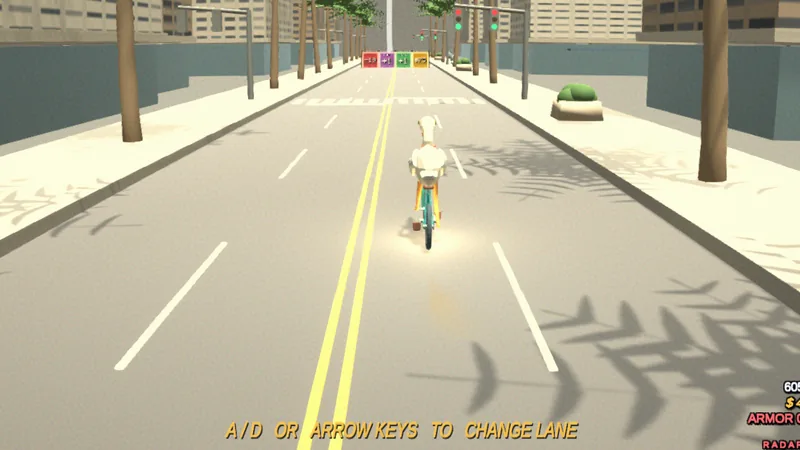
A pelican on a bicycle, flat out down a sunlit boulevard. Blue gates add speed and red ones take it away, so the fast line and the safe line are rarely the same one. Roll past a parked patrol and the chase starts - after that the only thing worth reading is the radar behind you.
- Controls
- A/D or arrow keys to change lane, SPACE for nitro
- Device
- Desktop and mobile — touch controls built in
- Players
- 1 player
- Price
- Free, forever
- Made by
- Kao Games
A pelican on a bicycle, flat out down a sunlit boulevard, with a police patrol somewhere behind and four lanes of traffic to argue with.
Blue gates give, red gates take
Your speed decays constantly and gates are how you get it back. The good one lands in a random lane, so every row is a small decision about how far across the road you are willing to move for it.
Gates are worth less the faster you already are, and the decay bites harder the faster you go. Between those two rules your speed settles at a cruising number instead of climbing forever, which is exactly what gives the chase a way to eventually win.
The patrol you woke up
Roll past a parked patrol and the chase starts. From then on the radar readout behind you is the only part of the HUD worth reading. A pursuer draws in behind the camera and works across the lanes toward you rather than teleporting onto your wheel.
Armour absorbs a hit. Nitro is a bolt you tap when the gap gets ugly. Neither is a rescue, and both run out.
Two of the four lanes are pointed at you
The road has four lanes and a solid double line down the middle. The two on your side run your way; the two beyond the line carry traffic head-on. Crossing that line is the whole point of the layout, because the good gate lands in a random lane and roughly half the time reaching it means riding the wrong way up a carriageway.
Changing one lane is a quick tap. Sweeping two or three deliberately takes longer, so a big move across the road is something you watch happen rather than something you teleport through. Nitro is worth 2.5 seconds of a large speed bonus and you start with a single charge, so it is a decision rather than a habit.
How to play
- A and D, or the arrow keys, change lane.
- Space spends nitro.
- The opening stretch is deliberately clear. Look at a blue gate and a red gate before anything is behind you.