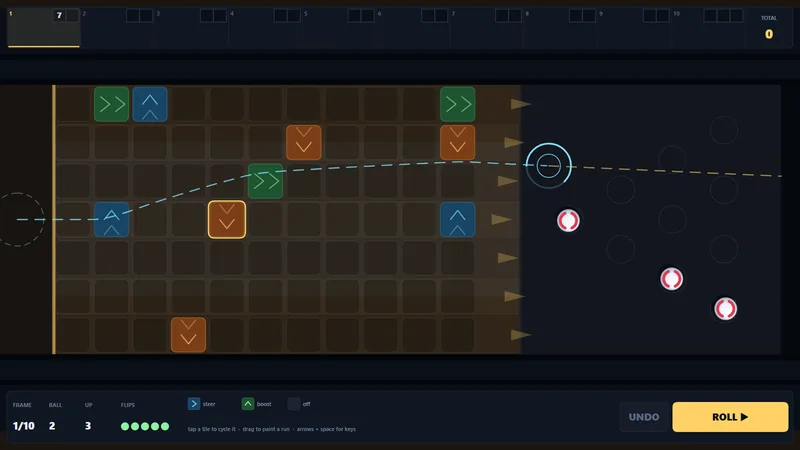
Ten-pin bowling with the throwing taken away from you. The ball always enters dead centre at the same speed, and the lane in front of it is a grid of conveyor belts you flip before letting go. Steering costs forward speed and boosting straightens the line, so angle and power come out of one budget of five flips a ball.
- Controls
- Tap a tile to cycle it, drag to paint a run; Space to roll
- Device
- Desktop and mobile — touch controls built in
- Players
- 1 player
- Price
- Free, forever
- Made by
- Kao Games
The ball enters dead centre at the same speed every time, and you have no say in it. What you do control is the lane: seven columns of conveyor belts between the foul line and the pins, and five flips to arrange them before you let go.
Angle and power are one budget
Steering belts push the ball sideways but drag its forward speed. Boost belts straighten the line and add pace. Both cost a flip, so every lane is the same trade asked differently - a wide angle into the pocket, or a fast ball arriving straighter.
A dotted preview shows exactly where the ball will go, and it is a promise rather than an estimate: it runs the same simulation the real roll does. If the preview reaches the pocket, the ball will.
Ball two is an edit, not a new lane
The belts you laid stay laid. You get five more flips, not a fresh grid, so the second roll is a repair of the first - and a layout that struck cleanly is rarely the layout that picks up a corner pin.
That is the whole reason a spare is harder here than a strike. Reaching an awkward pin often means undoing good work.
The lane fights back later
From the middle frames on, some belts rust solid and cannot be flipped at all, so the route has to go around them. Others turn fickle: they reverse the instant the ball rolls off, which means the lane you planned ball one on is not the lane you get for ball two.
Scoring is ordinary ten-pin - strikes and spares carry their proper bonuses - so a good frame early is still worth chasing while the lane is clean.
How to play
- Tap a tile to cycle it between steer, boost and off. Drag to paint a whole run at once.
- Arrows and Space work too; the arrows move by screen direction, not grid direction.
- Watch the dotted line before you roll. It is not a hint, it is the actual path.