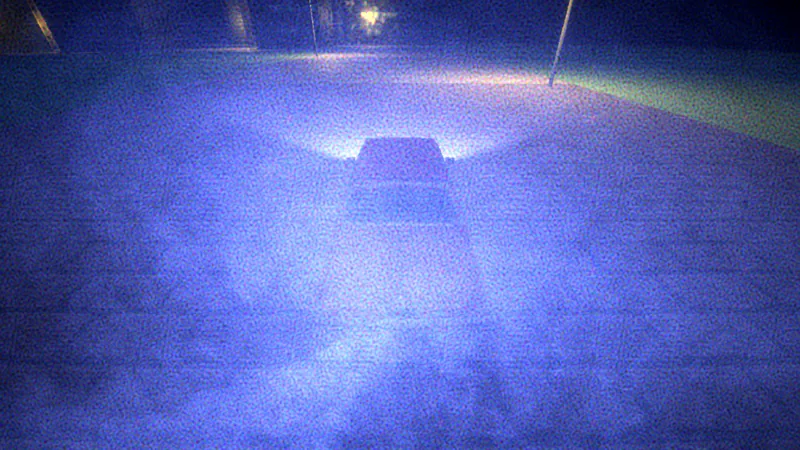
A PSX-era police chase where two clocks run against you at once: the fuel in the tank and the heat on your name. Every pursuit you survive widens the dragnet, so the road ahead is always a little more crowded than the one behind you.
- Controls
- WASD or arrow keys to drive
- Device
- Desktop — needs a keyboard
- Players
- 1 player
- Price
- Free, forever
- Made by
- Kao Games
A PSX-era police chase where two clocks run against you at the same time, and neither of them is a lap timer.
Two clocks, and neither of them stops
Fuel burns even when you are stationary, and burns faster the harder you are on the throttle, scaled by how quickly you are already moving. Sitting still is cheaper than sprinting but it is not free, so hiding is a delaying tactic rather than a plan.
Heat is the second clock, and it is worth being clear about what it is: pure elapsed time. It climbs one level every twenty-five seconds you stay alive, up to a maximum of five, and nothing you do makes it rise faster or fall back. Each level puts more cars on the map and makes them quicker. Two at the start, then four, seven, eleven, and sixteen at the top, chasing up to sixty per cent faster than they did on the first.
The dragnet actually comes to you
The obvious way to build a heat system is to spawn more cars in the distance. This does something different. Above heat level one, idle patrol cars stop working their own corner and start converging on a point near you, scattered at first and tighter as the heat climbs.
Hunting cars re-aim at where you are now on a fixed interval, so the map slowly closes rather than the traffic simply getting denser. Every pursuit you survive widens that net, which means the road ahead is always a little more crowded than the one behind you.
Near misses, and what they are worth
Driving scores one point per unit of ground covered. A near miss scores fifty. That gap is the entire argument the game keeps having with you, because the safe line and the profitable line are never the same line.
A near miss needs you to come within fourteen units of a police car and then get back out to twenty-four. Brushing past one and getting boxed in scores nothing at all. You have to survive the thing you just did for it to count, which is a more honest way of rewarding nerve than simply measuring how close you got.
How to play
- WASD or the arrow keys drive.
- Watch the fuel bar rather than the speedometer. Running dry ends a run just as firmly as being caught.
- Because heat is only a timer, there is no such thing as lying low until things calm down. The map gets worse on a schedule, so the question is how long you want to keep pushing.