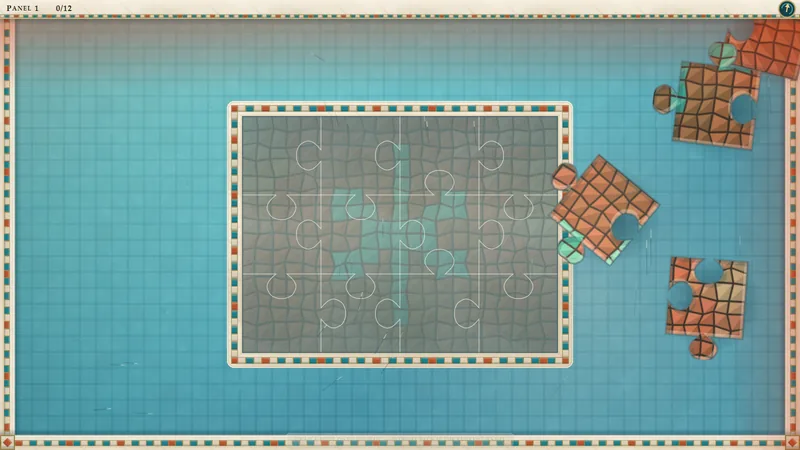
A jigsaw played on a live pool. Pieces circle on a gyre and drift toward one rim, and you have exactly one hand - holding a piece stops it drifting, which makes every board triage rather than a puzzle. A piece that reaches the edge is gone, and the mosaic finishes with a hole in it.
- Controls
- Drag a piece to its slot; fling one back before it drifts out
- Device
- Desktop and mobile — touch controls built in
- Players
- 1 player
- Price
- Free, forever
- Made by
- Kao Games
A mosaic has come apart on a pool, and the pool is going somewhere. Pieces circle on a slow gyre with a drift underneath it, and anything that reaches the rim is carried off for good.
One hand is the whole design
Holding a piece stops it drifting and levels it out, so your hand is a rescue as much as a placement. Every board is therefore triage: the piece heading for the rim is competing with the piece you already know where to put.
Flinging sends a piece back toward the middle, buying time you can spend elsewhere. A careful player can simply carry everything, but flinging is what lets you save two pieces drifting out at once.
The water has a shape
The gyre circulates pieces around the pool, which stops the board being a constant emergency. The drift underneath biases that circle toward one rim, and it is the drift that actually costs you pieces. It turns on a slow clock and is drawn as streaks with a compass on the panel.
Later boards add eddies that spin pieces where they sit, then a wandering drain that pulls toward itself. The pool stops being weather and starts having intentions.
A hole is an outcome, not a loss
Losing a piece ends nothing. The mosaic completes with a gap where it should have been, and the score is how much of the picture survived. A run only ends when a panel comes in under half.
Every mosaic is generated - palettes, motifs and laying styles combined fresh each time, each tile individually bevelled - so no two boards are the same picture and nothing is downloaded to make them.
How to play
- Drag a piece onto its slot. Near enough snaps in; a wrong drop returns it to the water.
- Flick a piece to fling it back toward the middle when you cannot reach it yet.
- Watch the compass. It points where the water is taking everything you are not holding.