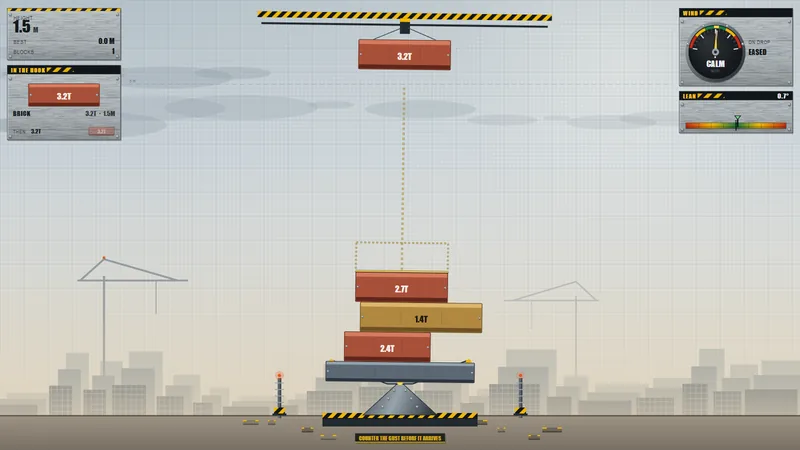
A stacking tower that sits in a cradle, so what matters is not where a block lands but what it does to the balance - weight times distance from the centre line. Wind rises as you climb and the next gust is on the panel before you drop, so the tower grows out into it as a staircase and every correction costs height.
- Controls
- Drag to aim and release to drop; arrows and Space also work
- Device
- Desktop and mobile — touch controls built in
- Players
- 1 player
- Price
- Free, forever
- Made by
- Kao Games
The tower does not stand on the ground. It sits in a cradle balanced on a point, so every block you add is a lever, and a block placed badly does not wobble - it tips everything underneath it.
Weight times distance, not height
A light plank hung well out to one side balances an anvil sitting close to the middle. That is the whole arithmetic, and the lean meter shows it directly, with a ghost tick for what the load alone is doing. The gap between the two marks is the wind.
The tipping force grows with how high the weight sits, so a sloppy placement that barely registers at four blocks will swing the tower at fourteen. Nothing in the game escalates difficulty on a timer - the mistakes you already made do it.
The wind tells you first
Wind drifts rather than gusting randomly, and the next step of it is printed on the panel before you drop. A standing wind needs a standing counterweight, which is why a tall tower ends up leaning out into it like a staircase rather than rising straight.
Reading the telegraph is worth roughly half again the height of ignoring it, and reading it backwards is worse than not reading it at all. Correcting costs height, because the block you hang to windward lands low - that trade is the game.
Five kinds of block
Bricks, planks, slabs, anvils and one lopsided piece whose centre of mass is visibly off to one side. Mass grows as you climb, so the blocks that arrive when the tower is tallest are also the ones that punish a bad placement hardest.
When it goes, it really goes: every block becomes a tumbling body carrying the rotation the tower had, which is usually enough to tell you which placement was the one that did it.
How to play
- Drag to slide the block along the hook, release to drop it. Arrows and Space work too.
- Watch the ON DROP line, not the NOW line. It is the wind your block will actually meet.
- A correction placed low is worth more than one placed high, and costs you less height.