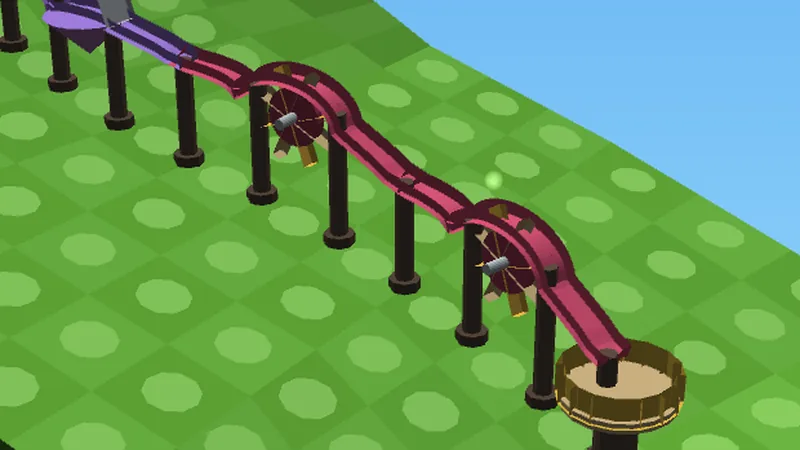
A hopper drops marbles down a track you build piece by piece across a green plate. Every stage does something to a marble - multiplies it, clones it, gambles it, fuses it - and whatever it is worth at the bucket is what you get paid. Nothing is locked behind a wall.
- Controls
- Mouse
- Device
- Desktop and mobile — touch controls built in
- Players
- 1 player
- Price
- Free, forever
- Made by
- Kao Games
A hopper drops marbles down a track you build piece by piece, across a studded green plate under a summer sky. Whatever a marble is worth when it reaches the bucket is what you get paid.
Every stage does something to the marble
Stages multiply what a marble is worth, clone it, speed it up, gamble it, or fuse it with another marble. A run is a sentence made of those verbs and the order matters, because a multiplier before a cloner is not the same as a cloner before a multiplier.
You spend the takings on three things: making the run longer, upgrading stages already in it, and improving the dropper at the top.
Nothing is locked
The entire catalogue is in the build sheet from the first screen. A piece meant for the end of a run simply costs what it costs at the end of a run, and if you want it early you can save for it.
Most pieces bend by up to thirty degrees, so the track wanders off across the field and no two factories end up the same shape. Pick a piece and a ghost of it appears on the end of your run, showing the shape it makes and which way it takes things, before you pay for it.
How to play
- Mouse only. Pick from the build sheet, check the ghost, then place.
- The camera chases the run from behind and a little to one side, so a track that wanders is easier to read than it sounds.
- No ads and no purchases. It was built for a phone, and it plays like one here.