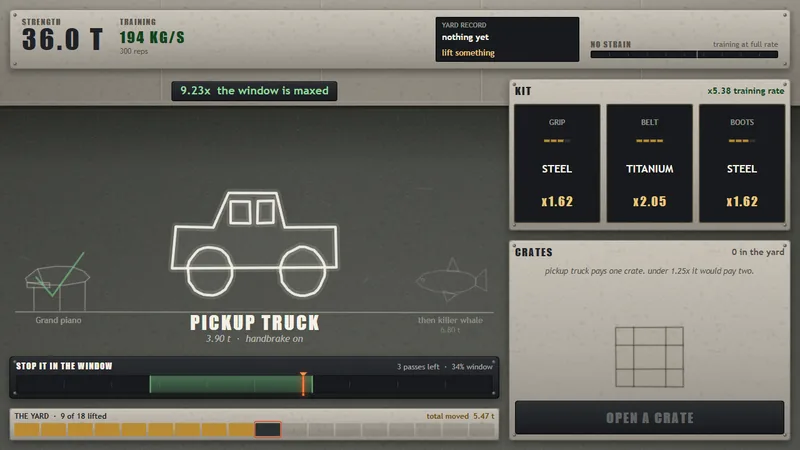
An idle lifting game where training and aim are the same number. Strength builds hands-free while you watch, and a lift is decided by stopping a sweeping marker inside your form window — a window that gets wider the further your strength runs past what the object weighs. So overtraining is not patience, it is accuracy you can bank. Miss anyway and the strain caps how fast you train until it heals, which makes every reach up the yard a real bet: eighteen objects from a kettlebell to a container ship, and the crates they pay roll the grip, belt and boots that multiply everything.
- Controls
- Space or tap to stop the marker; O opens a crate, then K, R or D to keep, reroll or drop it
- Device
- Desktop and mobile — touch controls built in
- Players
- 1 player
- Price
- Free, forever
- Made by
- Tiny Tycoon Co.
Heave is two games running on one number. Your lifter trains on their own, a rep at a time, whether you are watching or not. The other half is the yard: eighteen objects in a row, from a 16 kg kettlebell to a 290,000 kg container ship, and getting each one off the ground is a test of timing, not just strength.
Strength is also your aim
A lift is a marker sweeping across the form bar, and you have to stop it inside the form window. How wide that window is depends on how far your strength has run past the object's weight. Try at exactly its weight and the window is a thin sliver, and hitting it is a coin toss. At two and a half times its weight it covers nearly a third of the bar, and a steady hand almost never misses.
The window lands somewhere new on every attempt, so memorizing a spot does not help. Hesitate for three full passes of the marker and it counts as a failed lift.
Why waiting forever does not work
The window stops growing at about 2.8 times the object's weight. Past that point, training longer buys you nothing except time on the clock. Reaching early pays instead: lift an object at 1.25 times its weight or less and it pays two crates instead of one.
Reaching has a price, though. A failed lift adds strain, and strain slows your training until it heals. Pile on enough and you pull something, which drops training to a crawl until you recover. A failure while you are already strained digs the hole deeper.
So the best moment to try is in the middle. We tested this with a simulated lifter: trying at around one and a half to two times the weight beats both reaching too early and waiting too long.
Crates and kit
Every crate rolls one piece of kit: a grip, a belt or boots, made of hemp, leather, steel or titanium. The three pieces you wear multiply your training speed, and titanium in all three slots trains more than eight times faster than bare hands. Keep a roll, spend another crate to reroll it, or drop it.
The objects unlock strictly in order, and each one is about 1.7 times heavier than the last, so the only real decision is when. Every object you lift also raises your base training rate, which is what keeps the next rung within reach.
How to play
- Let your strength build. It trains by itself, and the yard shows how you measure up against the next object.
- Press Space or tap to start a lift, then press again to stop the marker inside the form window.
- Press O to open a crate, then K to keep it, R to reroll it or D to drop it.